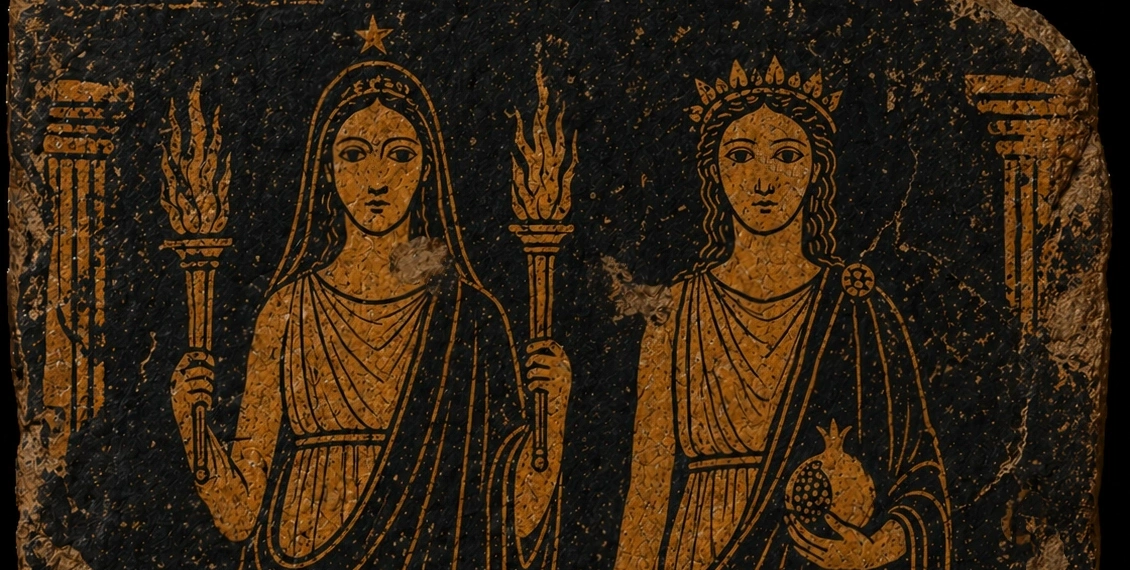
In another time, in the age of wonder, before stories became histories and before mysteries became laws, the Green Mother gave birth to a daughter who was the Princess of the Dawn.
Some knew the Green Mother by the grain, some by the thorn, some by the verdant hill where the dead slept. Some called to her at wells, some beneath oak and ash, some in the furrows before sowing, and some only in silence when the first leaf opened after frost. But in every tongue, she was the one by whom life rose.
Her daughter was filled with the strength of life, and the Green Mother raised her amongst the children of Pan: fauns and dryads, naiads and elves, well-spirits and the Fair Folk beneath the hills. She was beloved by all who knew her, and in turn she spread lovingkindness wherever she travelled.
Her mother gave her the task of painting all the flowers of the earth with brilliant colours. Every morning, she went about her work with the help of her retinue, staining blossoms with crimson and azure, waking the crocus from its sleep, touching the hawthorn into bloom, and weaving flowers into garlands to offer to her mother.
One day, the one who called himself Lord of the Hells spied the daughter of the Green Mother as she went about her morning ritual. He desired the Princess as a possession. He looked upon her body, her light, and her name, and thought: mine.
So he plotted to entrap her.
He went to his brother, the Authority, who had claimed the throne of the heavens, and together they schemed that the Jailer should take the Princess as his wife. Thus heaven would hold the law, hell would hold the dead, and between them humankind would kneel. The Authority taught his brother stolen secrets of dark magic by which the Jailer might trap the maiden.
The Jailer used these wicked enchantments to grow a wild daffodil and set it in the heart of the forest. Feeling the pull of the flower, the Princess wandered far from the protection of her friends and was drawn into the depths of the woods.
There she spotted the most curious blossom. Entranced by the spell, she was held fast. The ground opened beneath her, and the Jailer rose from the dark and seized her, dragging her below the roots of the world.
She shrieked in horror as he forced her down into his prison, and her cries echoed to the deepest caverns of the underrealm, where the great goddess Hekate was brewing her medicines: ambrosia, nepenthe, and kykeon, the old draughts of life, forgetting, and vision. The Witch Queen heard the cries of the Princess, and she was greatly disturbed.
In the prison below, the Jailer placed the Princess upon a throne of black stone and called her his queen before all the dead. He dressed her in death robes, set a crown of iron upon her head, and commanded that she be served at his table.
But the Princess folded her hands in her lap and looked past him as though he were not there.
She did not speak. She did not eat. She did not lift her eyes to meet his when he addressed her.
When he raged, she was thinking of the smell of rain on warm earth. When he pleaded, she was thinking of her mother’s hands braiding flowers into her hair. When he brought her gifts, jewels drawn from the deep earth, she let them fall without looking at them, and turned her mind instead to the colour of the sky on the last morning she had seen it, how the light had come through the trees in long golden shafts, how the dew had been cold on her feet.
The shades, the ancestors, the restless ones, the mound-sleepers, the nameless dead, and those who had waited so long they had forgotten the sound of rain watched from the shadowed edges of the throne room. They saw her refusal, and they remembered it.
The Princess did not move. She sat with her hands folded in her lap, silent beneath the iron crown. Yet beneath the throne, under the black stone where the Jailer had set her, something answered her remembering. The dead heard it before he did: a sound like roots searching for water. Then came other memories, rising through them without words: milk on the tongue, rain in dust, seed splitting its shell, the first green pressure under winter earth.
A hairline crack opened at the foot of the throne.
Days passed, or what passed for days in a place without sun. The Jailer raged and threatened and pleaded and went silent, and the Princess sat with her hands in her lap, holding herself the way the roots of trees hold the earth in winter.
But she was starving.
At last, alone in the dark, she found a pomegranate growing from the crack in the stone. It was not his gift, not from his table, nothing he had offered her. Its roots had drunk from the underworld, but its fruit had answered her hunger. She took it in her hands. She knew it belonged to the land of the dead and knew the old laws were deep. But she also knew she would not die because a thief on a throne had decreed it. So she ate of it, because she refused to starve.
The Jailer said nothing.
He had seen it, and he waited.
At last the children of Pan came to the Green Mother: fauns with broken pipes in their hands, dryads with bark split from weeping, naiads carrying bowls of darkened spring-water, elves from beneath the hills, thorn-wives with blood on their fingers, moss-fathers, well-spirits, and all the hidden peoples of leaf and root. They had searched the forest paths, the wells, the hollows of old trees, the thorn-thickets, the caves under the hills, and every place where the Princess’s laughter had once been heard. They came barefoot and bareheaded before the Green Mother, but none would meet her eyes.
“Mother of leaf and root,” they confessed, “we have lost the Princess of the Dawn.”
The Green Mother was overwhelmed with fear and grief, and the power of life which flowed from her heart to sustain all living things began to wane. She wandered the face of the earth and questioned everywhere she went, but no one knew or would say what had happened.
The hidden peoples could not find the road by which the Princess had been taken, but they did what the living can do when violence has taken what it should not have touched: they remembered. In wells, in caves, in elder groves, beneath hawthorn and hill, they whispered the Princess’s name until even human children learned it in their sleep.
Still, the world died around the Green Mother. Leaf and blade turned brown and then to dust. Meadows emptied, orchards cast down their fruit, and seeds lay silent in the furrows. She refused food and drink, all but for the kykeon, the sacred elixir of visions. Brewing the sacrament as she had been taught by the Goddess of Magic herself in aeons past, she fell into trance, and the Green Mother’s inner sight was opened.
Hekate appeared before her in the vision, holding torches ablaze in her hands.
“Green Mother,” said Hekate, Keeper of the Crossroads, “I come with torches lit and justice burning. I heard the cries of your child, but I did not see who captured her. Yet there is one who must have witnessed this wickedness. You must go to the Charioteer of the Sun.”
Hekate extended one blazing torch, and the Green Mother took it. Its heat was real in her hand. Together, the Green Mother and the Lady of Witchcraft ascended to the palace of the Sun.
“Charioteer!” demanded the Green Mother. “You who see all roads beneath the sun, remember what is owed between deathless ones. Speak truly: who kidnapped my daughter?”
The Charioteer bowed his head.
“O Great Mother of Life, I saw it all, and I kept silent; for that, I am ashamed. He sought to hide her abduction in the shadows of the trees, but the sun sees what shadow tries to keep. It was the Jailer who took your daughter, luring her from safety. Yet in this crime he did not act alone, for he had the blessing of his brother, the Authority, enthroned in the heavens.”
Hekate’s torches flared white. The Green Mother’s weeping ceased.
“Then the heavens have made themselves party to the crime,” said the Green Mother.
Hekate’s face hardened. “Then we go to the heavens.”
They turned from the Charioteer without farewell and stormed the citadel of the Authority. His angels swarmed them, iron wings beating and censers spilling plague-smoke, but Hekate’s magic swept them aside, and the goddesses strode into the throne room in glory.
The Authority sat upon a high white throne veined with gold, bright and pitiless. Before it, the white steps had been polished smooth by centuries of kneeling. His crown was a ring of open eyes, each one watching but none of them weeping.
Before that throne, the goddesses brought their charges.
Hekate, Witness of the Wronged, spoke.
“You have set your seal upon a theft of flesh and soul. You have made law into a chain and called violence order. You have given your blessing to the prison of the unchanging dark. Hear now what follows: the hands that fed your altars will close. The mouths that praised you will teach their children other names.”
The Authority raised a hand, and his angels surged forward to drag the goddesses from the throne room.
The Green Mother cried out, “O wicked throne-thief, you cannot avoid the harvest of what you have sown! Though by deceit you tricked the people of earth into worshipping you alone above all others, behold: humankind shall rise against you, and the tower you built from fear shall stand empty."
Then the Green Mother withdrew all her power from the earth, and everything stopped growing everywhere. Plants withered, trees shed their leaves in grief, and the cattle had no more calves.
Word passed from hearth to field, from well to crossroads, from grandmother to child, and humanity turned from the old sacrifices. They hid the grain from the altars and fed it to their children instead. They poured milk at the roots of trees. They left bread in the hollows of old trunks and flowers at crossroads. They buried their dead with bulbs beneath their tongues and pomegranate rind in their hands, commending them neither to the Jailer nor to the Authority, but to the earth, the dark, and the roads that open under the roots.
As the worship ceased, the Authority felt his power waning. Enraged by this loss of strength, he sent his punishing angels to earth, spreading disease and war as retribution for defying his will.
Still, the Green Mother and her faithful kept up their disobedience. The people endured the angels’ punishment and did not return to the old sacrifices. They kept grain from the altars, milk from the temple bowls, and their dead from the Jailer’s name. They sang to their children of the Princess of the Dawn, and the children learned that no throne, however high, could command the roots of the world.
And so the Authority began to diminish. There was no lightning, no overturned throne. It was the way a fire dims when no one tends it: a slow cooling, a gradual loss of light. The angels still raged across the earth, but their iron wings beat out of rhythm, and their plague-smoke thinned in the wind.
After the earth had suffered as long as the living world could bear, the Authority sat alone in his citadel and felt the silence where worship used to be. The altars were cold. The old prayers had changed their shape, turning toward the earth and the dark and the crossroads.
He looked at his hands and found them diminished.
He called his angels back from the earth, and in the quiet that followed, he sent word to Hekate and the Green Mother: it was enough. He would yield.
Hekate descended to claim the prisoner’s release. Carrying her blazing torches and the keys of hidden roads, she entered the underworld.
She passed through cave-mouth and barrow-door, through root-path and crossroads, through halls beneath hills and gates below the world. Everywhere she passed, she saw what the Jailer had done: walls driven through old roads, iron locks set on doors no hand had made, the dead gathered behind thresholds that had once been ways.
He had built a prison inside a mystery and mistaken the walls for law.
Standing in the great throne room of the Jailer, Hekate saw him seated beside the imprisoned queen, who sat death-pale upon the throne, her robes rotting around her, her chains sunk deep into the black stone.
Yet the crack at the foot of the throne had widened. Roots, white as bone and tender as newborn fingers, had pushed through the seams of the stone.
“O Jailer,” said Hekate, “the Authority has yielded. His altars are cold. Release your prisoner.”
In that moment, Hekate pulled off the cloak of the Crone which she wore, and was revealed in her full splendour.
The usurper on the throne trembled. At the sight of Hekate’s golden aura, the Princess felt the heat of her blood rise once more. The roots beneath the throne split the floor. Colour returned to her ashen cheeks. Her wounds closed, but the marks of the dark remained written beneath her skin. A crown of wild daffodils burst from her brow, root and stem and gold-throated blossom, and the iron crown cracked around them. It broke in pieces and fell ringing to the floor, and the chains which bound her loosened and slipped away.
The Jailer looked upon the broken iron crown and knew he had lost. As the Princess rose to stand at Hekate’s side, he spoke.
“O Mighty Hekate, I release to you my queen, but beware. She has tasted of the fruit of death. By the ancient decrees of the underworld, the one who eats or drinks of this place shall belong to this realm until the ends of the ages.”
Hekate took the Princess by the hand. Her majesty blazed around her.
“You speak a law older than your throne,” said Hekate, “but you have mistaken its bond for bondage. She has eaten in the land of the dead, and the dead have a claim upon her. That claim I do not break.
“But hear me, Jailer: the dead were here before your walls, and the underworld was old before your throne. She shall return to the dark because the dark has touched her. She shall rise from the dark because even here, life has answered her. What descends may rise. What dies may return. What is buried may flower again.”
As Hekate spoke, the Princess knelt and laid her hand upon the roots at her feet. They trembled beneath her palm. Then, from every crack in the throne room floor, green shoots pushed through the black stone: crocus, daffodil, asphodel, thorn, and snowdrops. The dead drew back in wonder. Then, one by one, they bowed, not to the Jailer, but to her.
The Princess turned then to the Jailer and spoke for the first time since her captivity.
“You named me queen of the dead,” she said, “but I name myself the Goddess of Spring. Every soul you have chained, I will one day set upon the road again.”
Then Hekate lifted her torches, and the gates of the underworld opened.
The goddesses burst forth from the ground, and the whole world rejoiced. The Green Mother wept tears of joy, and the love that flowed from her eyes watered the seeds of the dead plants. New leaves opened. The sun warmed in exultation at the return of the Princess. The animals began to rut. Crocuses and daffodils rose from the thawing earth. The voices of humanity were lifted in praise of the goddesses who had saved them from the prison of the unchanging dark.
From that time forward, winter was no longer the Jailer’s victory.
When the light fails and the cold comes, the Goddess of Spring descends again, but not as prisoner. She goes crowned in daffodils, with Hekate beside her, and the dead lift their faces when she enters. Above, the Green Mother waits. The faithful wait with her, tending small fires, singing to the Spring Queen, and leaving offerings at the roots of trees.
And when the first warmth stirs beneath the soil, Hekate takes her lover by the hand and leads her upward through the adamantine gates, through the labyrinth, through the cold earth, into the light. The whole living world, which has been holding its breath, releases.
Hail to the Green Mother, Root of Grain and Thorn, whose grief became the winter and whose joy became the rain.
Hail to the Spring Queen, the Flower-Crowned, the Guide of Returning Souls.
Hail to Hekate Paionios, Torch-Bearer, Key-Keeper, Healer of the Earth.
Leave a Reply