A Pagan Spring Hymn for Ēostre and Ing Frēa
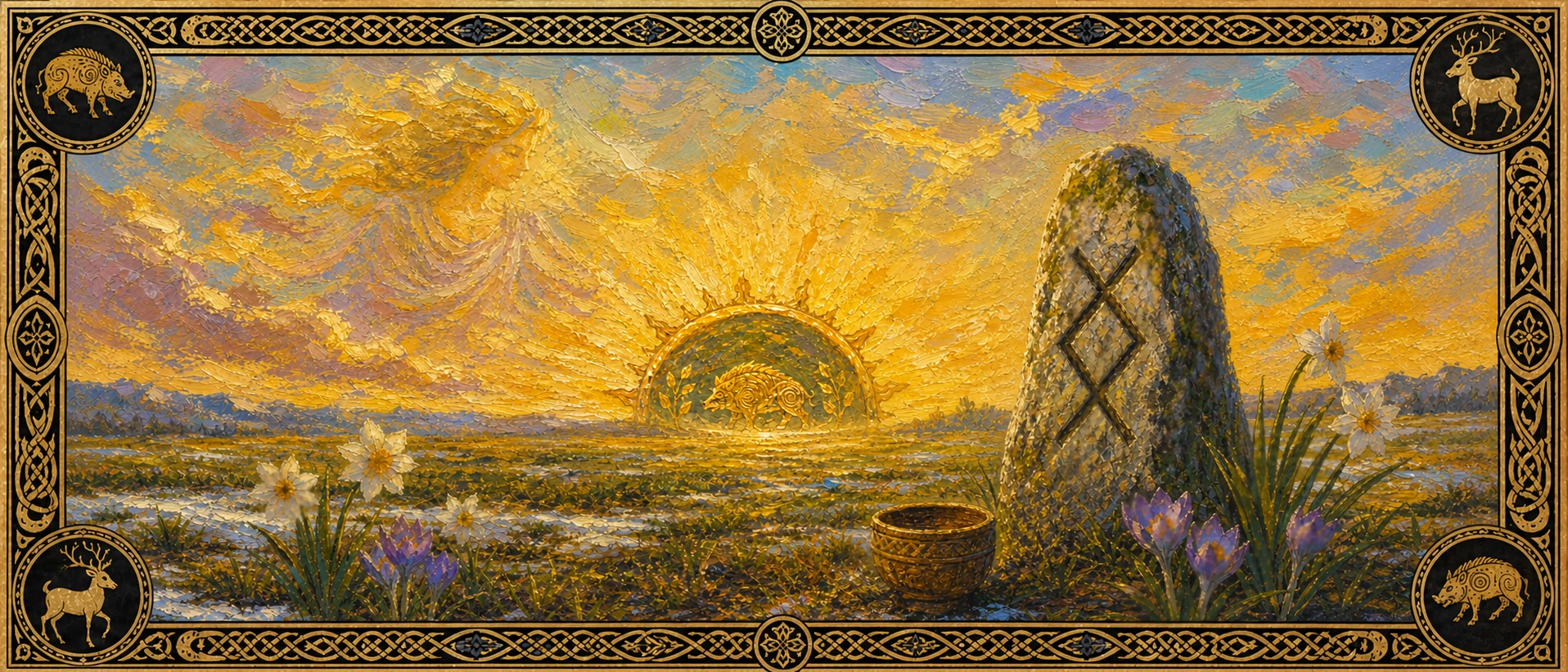
Ēadiġ is Dæġ is a modern Old English devotional refrain meaning “Blessed is [the] day.” This spring hymn celebrates the return of light, warmth, and greening life after winter, drawing on Old English language, seasonal devotion, and a pagan sense of sacred renewal.
The hymn may be sung to the tune EASTER HYMN, commonly sung with Christ the Lord Is Risen Today, reclaiming a familiar melody for a different sacred imagination: dawn returning, seeds waking, the earth greening, and the living world rejoicing.
Ēadiġ is Dæġ
“Blessed is [the] Day” | To the tune EASTER HYMN, commonly sung with “Christ the Lord Is Risen Today”
I.

Earth and sky grow bright today,
Ēadiġ is dæġ!
Winter’s grip has passed away,
Ēadiġ is dæġ!
Life returns to frozen ground,
Ēadiġ is dæġ!
Green and gold and light abound,
Ēadiġ is dæġ!

II.

Hail the dawn’s returning flame,
Ēadiġ is dæġ!
Ēostre, Lady, we proclaim,
Ēadiġ is dæġ!
Seeds once sleeping in the earth,
Ēadiġ is dæġ!
Wake to wonder, wake to birth,
Ēadiġ is dæġ!

III.

Ing Frēa rises to his throne,
Ēadiġ is dæġ!
Into warmth the cold has grown,
Ēadiġ is dæġ!
Sun lifts high his amber crown,
Ēadiġ is dæġ!
Light and warmth come pouring down,
Ēadiġ is dæġ!

IV.

Sing we as the seasons turn,
Ēadiġ is dæġ!
Watch the greening earth return,
Ēadiġ is dæġ!
Raise the cup and raise the voice,
Ēadiġ is dæġ!
All the living world: rejoice!
Ēadiġ is dæġ!
by Geoffrey Dice, March 2026
The Gods of the Hymn
Ēostre is a lightly attested Anglo-Saxon goddess associated with the spring season and the returning light of the year. She is often connected with a much older, reconstructed Proto-Indo-European figure: the dawn goddess *h₂éwsōs.1 Her name belongs to a dawn, east, and shining word-family, ultimately connected with roots meaning “to shine” or “glow red.” Related dawn figures and dawn words appear across Indo-European traditions, including Vedic Uṣás, Greek Eos, Roman Aurora, and Lithuanian aušra. The early medieval writer Bede says that the Old English month Ēosturmōnaþ, roughly April, was once named for the goddess Ēostre, and that feasts had been held in her honour during that season.2
Ing Frēa is a reconstructed devotional name meaning “Lord Ing.” Ing is an Old English figure whose surviving traces are both mythic and genealogical; Richard North connects Ingui or Ing with royal ancestry and the wider Ingvi-Freyr complex.3 Frēa means “lord” or “king” and is cognate with the Old Norse divine name Freyr.4
Freyr is one of the Vanir, a family of gods in Old Norse tradition especially associated with fertility, prosperity, pleasure, peace, and the fruitfulness of the living world. Some modern English-speaking Heathens render Old Norse Vanir as “the Wanes,” a modern Anglicization. In my own devotional language, I sometimes use the Wani, pronounced roughly WAH-nee: a speculative Old English-flavoured collective inspired by possible wan- traces in Old English. This is devotional reconstruction, not attested historical vocabulary.5
Freyr is associated with peace, prosperity, good harvests, fair weather, rain, sunshine, and the fruitfulness of the land.6 He’s also one of the least coy fertility gods in the Germanic imagination. Adam of Bremen describes an impressive image of him at Uppsala, and the proud Viking Age Rällinge statuette offers some very hard evidence for his cautious identification as Freyr.7
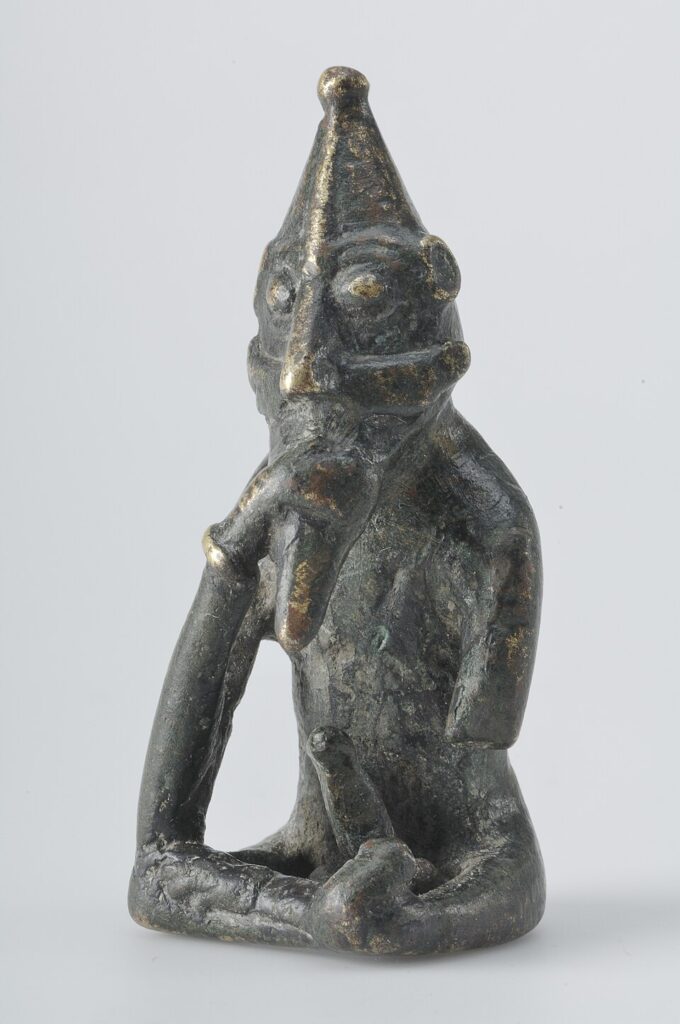

The point is not subtle: Freyr’s abundant power is generous, fertile, pleasurable, and cheerfully embodied.
In this hymn, Ēostre is the dawn-bringer, calling the year back into light, while Ing Frēa brings flourishing to fields and the living world of human community.
Pronunciation Notes
For pronunciation, it may help to think of the refrain as:
A-ah-dee-y iss dæ-y
The more precise Old English pronunciation is approximately /ˈæɑː.dij is dæj/. In Ēadiġ, the opening vowel is not a simple long e. The spelling ēa represents a long Old English diphthong: it begins near the a in cat and opens toward an ah sound.
The æ sound in dæġ is also the a in cat, so dæġ is roughly dæ-y. Begin with the cat vowel, then let the final ġ soften into a small y-glide. It should not sound exactly like modern English day, and it should not sound like dag.
The s in Old English is should stay soft and voiceless: iss, not modern English iz. The dotted ġ is a modern pronunciation aid. It shows that the final g in Ēadiġ and dæġ is softened into a y-like glide.
Ēostre may be pronounced roughly AY-ohs-treh. Ing Frēa may be pronounced slowly as ING-g FRÆ-ah, but in speech or song Frēa will usually compress into one syllable: something like FRA-AH. Begin with the cat vowel and let it glide toward ah, without giving the second part a separate beat. In Ing, pronounce the final hard g; it is not just modern English ing with the final sound swallowed. Frēa has the same long ēa diphthong heard in Ēadiġ.
Quick Pronunciation Guide
- Ēadiġ is dæġ: A-ah-dee-y iss dæ-y
- IPA: /ˈæɑː.dij is dæj/
- ēa: starts near the a in cat, then opens toward ah
- æ: the a in cat
- s: soft and voiceless, as in sun; say iss, not iz
- ġ: a softened y-glide, as in dæ-y
- Ēostre: AY-ohs-treh, not modern English Easter
- Ing Frēa: ING-g FRA-AH
Notes
- For the Indo-European dawn word and dawn-goddess complex, see J. P. Mallory and D. Q. Adams, The Oxford Introduction to Proto-Indo-European and the Proto-Indo-European World (Oxford: Oxford University Press, 2006), 300; M. L. West, Indo-European Poetry and Myth (Oxford: Oxford University Press, 2007), 185, 218, 224–225. ↩
- Bede, De temporum ratione, chapter 15, “On the English Months,” trans. Faith Wallis in Bede: The Reckoning of Time, Translated Texts for Historians 29 (Liverpool: Liverpool University Press, 1999), 53–54. For a modern focused study of Ēostre, Hreda, and the methodological difficulties around early Germanic goddesses, see Philip A. Shaw, Pagan Goddesses in the Early Germanic World: Eostre, Hreda and the Cult of Matrons (London: Bristol Classical Press, 2011). ↩
- The Old English Rune Poem, stanza for Ing. On Ing or Ingui in relation to Yngvi-Freyr, fertility cult, and Anglian royal genealogy, see Richard North, Heathen Gods in Old English Literature (Cambridge: Cambridge University Press, 1997), especially 26–43. ↩
- For frēa as “lord, king” and its cognacy with Old Norse Freyr, see An Anglo-Saxon Dictionary, ed. Joseph Bosworth and T. Northcote Toller, s.v. freá. ↩
- For North’s discussion of possible Old English wan- traces, including Wan-seoc and a possible Northumbrian *wani, see Richard North, Heathen Gods in Old English Literature (Cambridge: Cambridge University Press, 1997), 52. ↩
- On Freyr as associated with peace, fertility, rain, sunshine, good harvests, and prosperity, see Rudolf Simek, A Dictionary of Northern Mythology, trans. Angela Hall (Cambridge: D. S. Brewer, 1993; repr. 2007), s.v. “Freyr,” 91–92; Encyclopaedia Britannica, “Freyr.” ↩
- Adam of Bremen, Gesta Hammaburgensis ecclesiae pontificum, book 4, chapter 26; Swedish History Museum, Rällinge statuette, object no. 109037_HST. The museum identifies the statuette as Frey or Freyr. For broader caution about identifying Viking Age figurative objects securely with named Norse gods, see Neil Price, “What’s in a Name? An Archaeological Identity Crisis for the Norse Gods (and Some of Their Friends),” in Old Norse Religion in Long-Term Perspectives: Origins, Changes, and Interactions, ed. Anders Andrén, Kristina Jennbert, and Catharina Raudvere (Lund: Nordic Academic Press, 2006), 179–183. ↩